Health and Safety Policy for Commercial Waste Removal Docklands
 Commercial Waste Removal Docklands operates a robust health and safety policy designed to protect employees, contractors, clients and the wider community involved in commercial waste and rubbish services. This policy outlines responsibilities, safe systems of work, and the controls we apply across our rubbish collection and commercial rubbish removal Docklands operations. It applies to all sites, vehicles and businesses within our service area and is intended to support consistent, safe behavior while minimising risk to people and property.
Our commitment is to maintain a safe working environment for everyone engaged in waste collection and waste management Docklands activities. Management will provide the resources and leadership necessary to implement this policy. All staff must follow safe work instructions, attend required training, and report hazards immediately. We emphasise continual improvement and aim to reduce incidents through proactive hazard identification and worker engagement.
 The scope covers routine commercial waste removal, ad-hoc bulky rubbish removals, secure handling of mixed commercial refuse, and liaison with clients to ensure safe access and clear loading areas. We coordinate risk assessments for new accounts and repeat reviews for high-risk contracts. Employees are expected to participate in risk assessments and contribute practical suggestions that improve site safety and efficiency.
Responsibilities and Risk Control Measures
Senior leadership retains ultimate responsibility for health and safety policy enforcement, but duty holders at every level share responsibilities. Line managers must ensure safe rostering, fitness for work checks, and competency verification for vehicle operators and waste handlers. Employees have a duty to take reasonable care of themselves and others and to use provided PPE correctly. Contractors and sub-contractors are expected to operate in line with our documented standards for Docklands rubbish removal.
 Routine controls implemented include vehicle and equipment inspections, clear traffic management plans for loading bays, segregation of hazardous items, and safe manual handling practices. Our operational checklist, used daily by drivers and crew, contains clear steps to prevent slips, trips and falls, to manage sharp objects and to protect against exposure to contaminated waste.
We maintain documented safe systems of work that cover:
- Vehicle checks and secure loading procedures;
- Use of mechanical aids and correct lifting techniques;
- Isolation of hazardous materials and immediate notification for specialist removal.
Training, PPE and Operational Safety
Training is central to our policy. All operatives receive induction training, on-the-job supervision, and refresher courses on manual handling, hazardous waste awareness and vehicle safety. Specific roles require additional certification; records are maintained and reviewed regularly. We encourage a learning culture where near-miss reporting is used constructively to prevent recurrence.
 Personal protective equipment is provided to all crew members and must be used as specified: high-visibility clothing, gloves, safety boots, eye protection and respiratory protection where required. Regular audits verify correct PPE usage and fit. Our rubbish company service area procedures require visible identification of PPE needs at each site, reinforced by signage and crew briefings before work starts.
 Vehicle safety and site procedures include secure parking practices, reversing aids, trained banksmen for complex access, and scope for temporary traffic control when working near busy roads. We set standards for bin placement and lifting zones to keep pedestrians and client staff safe during commercial waste collection Docklands operations. Fuel, electrical and mechanical hazards are controlled through scheduled maintenance and permit-to-work systems for high-risk tasks.
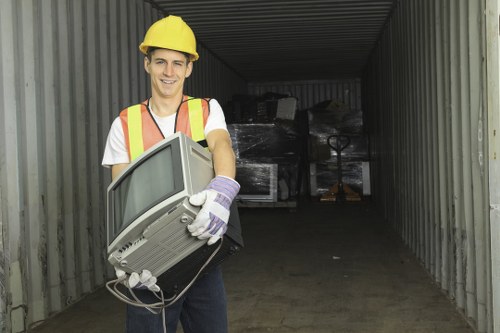
Handling controlled and hazardous waste is performed only by trained personnel following strict segregation rules and labelling. Spill response kits are carried on vehicles and crews are trained to contain and report spills, with escalation for specialist disposal where needed. We actively manage sharps, chemical containers and electronic waste to prevent injury and environmental harm.
Emergency procedures and first aid provisions are in place across our service area. Incident reporting and investigation protocols are designed to identify root causes and implement corrective actions. We maintain a clear, documented process for recording, investigating and learning from accidents and near misses; outcomes influence risk assessments and training plans.
Monitoring and review are continuous. Performance metrics such as incident frequency, audit results and training completion rates are reviewed monthly and inform management reviews. The policy is formally reviewed annually or whenever operational changes, new risks or legislative updates require revisions. Everyone employed in the waste management Docklands sector is expected to cooperate fully with these reviews.
Environmental protection is integral to our health and safety approach. We promote segregation at source, safe storage and secure transport to minimise contamination risk. Noise, dust and odour controls are applied where necessary, and our teams are briefed to work considerately in mixed-use areas. Waste minimisation and correct disposal pathways support safer operational environments and reduced community impact.
Policy adherence is mandatory. Non-compliance will be addressed through supervision, retraining or disciplinary measures as appropriate. We maintain open channels for staff to raise safety concerns without fear of reprisal and to suggest improvements to the commercial rubbish removal procedures in the Docklands service area.
In summary, our health and safety policy for commercial waste removal Docklands sets out a practical, enforceable framework to manage risks to people and property, ensures legal and industry standards are met, and promotes continuous improvement through training, monitoring and cooperation across all parts of the organisation.